
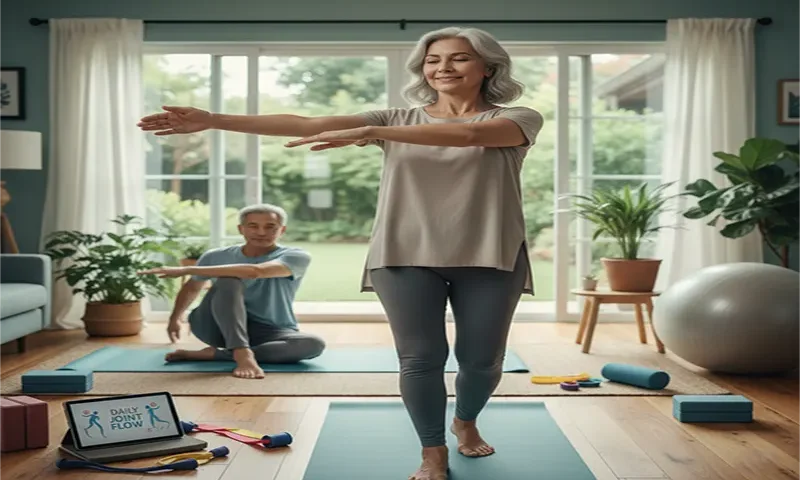
The Science: Why Mobility Matters More Than Strength
While muscle strength is important, mobility is the foundation. Mobility is your ability to move a joint actively through its intended range of motion. Without it, strength training can actually lead to injury. For those over 60, regular mobility work:
- Lubricates the Joints: Movement triggers the production of synovial fluid, which nourishes cartilage.
- Reduces “Inflamm-aging”: Studies show that structured low-impact movement can decrease inflammatory markers like IL-1β by up to 34%.
- Prevents Falls: Better ankle and hip mobility allows for a steadier gait and quicker reactions to uneven surfaces.
Phase 1: The Morning “Oil Change” (Wake-Up Mobility)
Before you even leave your bedroom, you can begin a “lubrication” routine. These movements are designed to be done slowly and gently.
1. Wrist and Ankle Rolls
Stiffness often starts in the extremities.
- How to do it: While seated on the edge of your bed, lift one foot and rotate the ankle in slow circles—10 times clockwise, 10 times counter-clockwise. Repeat with the wrists.
- Why it helps: Improves circulation and reduces the morning “stiff” feeling in the hands and feet.
2. Seated Cat-Cow
This is a modified version of the popular yoga pose for those who find kneeling difficult.
- How to do it: Sit on a sturdy chair with feet flat. Inhale as you arch your back and look slightly upward (Cow). Exhale as you round your spine, tucking your chin to your chest (Cat).
- Why it helps: It maintains spinal flexibility, which is crucial for posture and preventing lower back pain.
Phase 2: Lower Body Foundations (Hips and Knees)
The hips and knees bear the brunt of our weight. Keeping them mobile is the secret to walking comfortably.
3. Chair Squats (The Sit-to-Stand)
This is arguably the most important functional movement for seniors.
- How to do it: Stand in front of a sturdy chair. Slowly lower your hips until you lightly touch the seat, then stand back up. Use your arms for balance, but try not to use them to “push off.”
- Goal: 10–12 controlled repetitions.
- Pro Tip: If your knees ache, don’t go as low. Even a “mini-squat” builds the necessary quad strength to protect the knee joint.
4. Seated Hip Rotations
Hip stiffness is a leading cause of “shuffling” gaits.
- How to do it: Sit tall. Lift one knee slightly and rotate the leg in and out like a gate swinging on a hinge.
- Why it helps: This “greases” the hip socket and helps with daily tasks like getting in and out of a car.
Phase 3: Upper Body Freedom (Shoulders and Neck)
Shoulder mobility allows you to reach high shelves and get dressed without assistance.
5. Wall Angels
This exercise works on both shoulder mobility and “thoracic extension” (flattening out the rounded upper back).
- How to do it: Stand with your back against a wall. Raise your arms to a “goalpost” position. Slowly slide your arms up the wall as high as you can without your back arching away from the wall, then slide back down.
- Why it helps: It counteracts the “slouch” that often comes with age and opens up the chest.
6. Shoulder Shrugs and Rolls
- How to do it: Gently lift your shoulders toward your ears, hold for one second, and drop them down. Follow this with slow backward circles.
- Why it helps: Releases tension in the trapezius muscles and prevents “frozen shoulder.”
The “Triple Threat” of Low-Impact Cardio
In addition to specific mobility drills, three activities stand out for joint longevity:
| Activity | Primary Benefit | Why it’s Joint-Friendly |
| Swimming | Full-body range of motion | Water’s buoyancy removes 90% of body weight stress. |
| Tai Chi | Balance and Proprioception | Slow, “meditative” movement focuses on weight shifting. |
| Stationary Cycling | Knee lubrication | The circular motion delivers nutrients to knee cartilage without impact. |
Safety Guidelines for Beginners
- Warm the Joints First: Use a warm towel or take a warm shower before exercising. Heat relaxes the “periarticular” soft tissues, making them more pliable.
- The “2-Hour Pain Rule”: It is normal to feel some “work” in the muscles, but if you have sharp joint pain that lasts more than two hours after your session, you did too much.20 Scale back next time.
- Hydrate for Elasticity: Cartilage is roughly 70–80% water. If you are dehydrated, your joints will literally feel “crunchier.”
- Avoid Locking Out: Never fully “lock” your elbows or knees during movement. Keep a “soft” bend to ensure the muscles are doing the work, not the bone-on-bone joint.
Summary
Mobility is the “savings account” of your independence. By spending just 15 minutes a day on these low-impact movements, you are investing in a future where you can continue to garden, play with grandchildren, and move through the world without fear of falling.

